Topics

Enterprise AI Adoption

How large organisations move AI systems from pilot into governed production, including data foundations, access control and operating model changes.

28
Talks
58
Speakers
39
Organizations

Latest talks

PepsiCo's Six-Agent System for Account Managers, and What It Cost to Build

The rare enterprise session that describes the wiring rather than the outcome. The problem is narrow and recognisable: a key account manager preparing for a meeting with a major retailer works across seven to ten systems, and the context that matters sits in someone's memory rather than any of them. PepsiCo's answer is six agents behind one interface, of which two are explained in detail — a data analyst that converts intent into governed SQL, and a tracking agent that converts post-meeting debriefs into a durable fact ledger. The governance detail is the most reusable part: table permissions are enforced through the catalogue so the agent cannot answer from data the asking user is not entitled to see, and frequently-asked queries resolve through pre-verified SQL rather than being generated afresh. Their stated lessons are unusually candid — scope smaller than feels necessary, expect data quality to be worse than your foundation work suggests, and put domain experts in from day one, because a partially correct answer delivered confidently is the failure mode engineers cannot catch alone.

Microsoft Build

Tool Sprawl Is the Agent Problem Nobody Priced: Foundry Tools at Build 2026

Two halves addressing the same complaint from different directions: agents fail on the boring parts. Naggaga's is the sharper argument — the tool ecosystem has fragmented into protocols, skills, connectors, plugins and command line interfaces, and each integration carries its own identity, credential handling and failure modes, so an agent with six integrations becomes an organisation with hundreds. Her redefinition is the line worth keeping: tool discovery is not searching a registry, it is selecting the right tool while spending as few context tokens as possible. Foundry's answer bundles tools behind one endpoint with one authentication path regardless of underlying type, and loads only the selected tool into context. Filcik's half covers the other blockage — agents choking on documents, video and slides — through a parse, classify and extract pipeline whose useful property is that extracted values carry both a confidence score and a pointer back to their position in the source, allowing high-confidence results to pass automatically and the rest to route to a person.

Microsoft Build

Agents That Acquire Skills Cannot Be Validated Once

The framing worth separating from the product is that agents are no longer static routers shuffling requests between fixed tools; they acquire skills, generate memory and accomplish things nobody programmed. A router can be tested exhaustively because its behaviour is bounded by configuration. A system that gains capability during operation cannot, because what it does next week depends on what it accumulated this week. The response described is continuous evaluation fed by every action and cost signal — the right shape of answer and a considerable operational commitment, since you end up running an evaluation apparatus permanently at a cost proportional to the thing evaluated. The quieter shift is agents woken by events rather than requests, which removes the natural boundaries a requester provides: unbounded cost, unattributable actions, and no clear answer to who authorised any particular piece of work.

Microsoft Build

The Return Is Largest Where the Engineer Is Weakest

The finding that contradicts how most teams deploy AI assistance is stated almost in passing: the tenfold return arrives where an engineer is weakest rather than strongest, so someone without a security background suddenly shows a better security posture. That reverses the usual rollout order, which gives these tools to the strongest engineers first on the theory that leverage compounds on capability. It also creates a verification problem, because the reviewer most likely to be assigned shares the same gap. The speaker who previously ran the foundation behind Kubernetes brings a specific scepticism about lock-in, framed as this era already reproducing the last one's portability and cost-control problems — though the sharper observation is that context held in implicit memory or a conversation window has no export format at all. Their overnight scheduler blocks only for architectural decisions, which is a well-drawn line with no one watching it.

Microsoft Build

Nadella's Argument: Enterprises Stop Consuming the Frontier and Join It

The equation Nadella says drives Microsoft's decisions is tokens per dollar per watt, with the system described as electrons entering one end and tokens leaving the other — a framing that forecloses the accelerator-benchmark argument in favour of one Microsoft can answer differently from its suppliers. Two claims sit beside each other. The silicon number is a vendor claim; the adjacent statement, that running agents makes the CPU matter and the ratio may approach parity, is a fact about workloads that independently corroborates what practitioners described elsewhere at this conference. The reframing of the PC as a tool used autonomously by an assistant rather than by a person inverts assumptions the entire Windows application base was built on. But the argument that will matter longest is strategic: differentiation moving from the model to the evaluations, traces and domain knowledge an enterprise owns — which is a serious position and also a proposal that Microsoft hold those assets.

Microsoft Build

The Connector List Is the Product and the Risk Surface

What generalises past the products is where agents get their reach: connectors for mail, chat, drive, calendar and contacts, with search across them. That list is the substance, because an agent with access to a person's calendar, correspondence and documents can do work another cannot — not by reasoning better but by knowing things. The example offered is ordinary and the shift underneath is not: the value of a meeting summary is not the summary, it is that attending stops being the only way to know what happened, which changes the calculus of every scheduling conflict. The uncomfortable part is that the connector list is simultaneously the product and the risk surface. An agent that can search mail to answer a question can search mail to answer a question it was manipulated into asking, and the permission model governing a person was not built for that.

Google I/O

Fewer Than 20% Are Using AI at All, and Aggregates Hide Who Left

The framing figure should appear in more discussions of AI adoption: in the markets under consideration fewer than twenty per cent of people are using AI at all, with benefit concentrated in developed markets. Every debate about economic impact assumes access, and this session concerns the four-fifths for whom the question has not arisen. Digital literacy is named as the representative constraint, and it matters more than infrastructure because the sequence has already run once — mobile reached these markets faster than forecast, and those who missed out were not the uncovered but those who could not use what coverage delivered. The technical description is a distribution argument rather than a product one, and depends on the layers above being built by people with local knowledge, which the same conditions suppress. The operational discipline is what makes it credible: segmented retention reviewed every week or two, because aggregates rise while intended beneficiaries leave.

MWC Barcelona

Clients See a Cost Opportunity Where There Is a Revenue One

The most useful sentence is a diagnosis of how clients are getting it wrong: they see a cost opportunity rather than a revenue one. That framing decides everything downstream, because an organisation treating AI as cost reduction measures success by what disappears and arrives at a smaller version of what it already was. The market number offered — seventeen per cent index growth in 2025 that nobody foresaw — is deployed against bubble anxiety and argues in both directions, since unforecast gains are poor evidence for confidence in any current consensus. The panel then locates the real source of instability outside technology entirely, in three geopolitical situations generating enough uncertainty to dominate planning, which is a corrective worth taking seriously at a technology conference. Their closing question about thriving across multiple futures is correct and sits uneasily beside the cost framing they diagnosed at the start.

World Economic Forum Annual Meeting

"The Problem Isn't a Bubble, It's Rationing": Davos on Financing the Buildout

The session's organising claim is that the bubble conversation is a category error: for the next one to three years the binding problem is rationing capacity, not overbuilding. Friar supplies the strongest evidence anyone offered publicly this week — compute constraints delayed frontier models by six to eighteen months, which makes the shortage a fact about a roadmap rather than a claim about demand. Where the session is less useful is the critique it declines to engage. Asked about circular financing, Friar identifies the implication that demand is not real and rejects it, which answers the weakest version of the argument; the stronger one accepts that demand is real and observes what happens to a loop when the external funding sustaining it slows. Nobody tests it, which is unsurprising given that every participant sits inside the arrangement. The vocabulary — generational opportunity, a fast river you want your boat in — is the register of allocation, in which every answer arrives as a reason to move faster.

World Economic Forum Annual Meeting

The Fiscal Position Is Now a Bet on Productivity

The most consequential thing said here is not about technology: the only route out of the deficit position is a productivity boom, and without one the consequences of that spending worsen. That makes the AI question load-bearing in a way most discussions of it are not. The historical parallel offered — the computer revolution visible everywhere except in the productivity statistics — cuts both ways, because the gap before those gains materialised was well over a decade. The evidence for optimism is a 2.8 times return in bounded proof cases, immediately qualified by the observation that enterprise-scale adoption requires spreading the technology across every function and will take time. The distance between those two statements is the whole adoption problem, and nobody supplies the number the fiscal argument depends on. The panel's observation that much of the industrial base sits in Asia is a significant qualification to an argument about exceptionalism.

World Economic Forum Annual Meeting

Agents Will Not Swipe a Credit Card

The claim worth arguing about here is that the native currency for AI agents will be crypto, because agents will not carry cards and blockchain is the interface most native to them. It comes from someone with an obvious interest in it being true, which is a reason to examine it rather than dismiss it. The strong part is structural: card networks assume a cardholder who can be contacted and can attest to a transaction, and an autonomous process breaks each of those assumptions. What does not follow is the conclusion, because nothing prevents existing networks issuing delegated credentials with limits and revocation. The panel's most direct voice calls these areas highly speculative with hard use cases, and both positions can hold, since stablecoins and speculative assets are separable in a way the panel treats as one thing. The quieter claim about tokenised government instruments is the more consequential one.

World Economic Forum Annual Meeting

A Strategy Built on Diffusion Rather Than the Frontier

The framing difference made explicit here is worth more than the numbers: the approach described concentrates on diffusion and does not talk about artificial general intelligence. That is strategic rather than rhetorical, because a programme organised around reaching a threshold prioritises frontier capability while one organised around diffusion prioritises getting existing capability into industries — different investment, metrics and definition of success. The operational emphasis follows: building scalable systems in production across many datasets, and lowering the cost of using AI through cloud-level optimisation. That is where diffusion and cost converge, since the marginal adopter is by definition more price-sensitive than the last one. Open weights fit the same pattern as distribution mechanism rather than philosophy. What the session avoids is what is given up, and the position is the opposite of the one taken by the frontier labs elsewhere at this conference.

World Economic Forum Annual Meeting

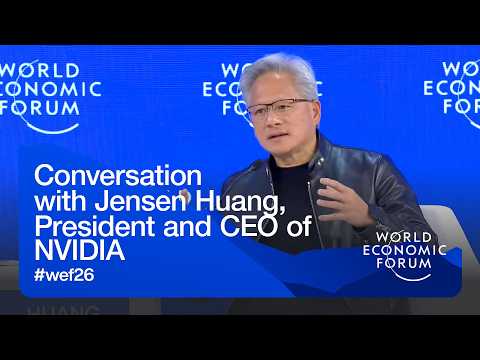
Huang's Five-Layer Cake: The Infrastructure Argument He Took to Davos

Huang brings a diagram to Davos: AI as a five-layer cake running energy, chips, cloud, models, applications — with economic benefit landing at the top and every layer below it a precondition. His argument for why this is a genuine platform shift rather than a product cycle is the strongest part, and it does not rest on his commercial position: software was pre-recorded and worked on structured data, whereas a machine that reasons about unstructured input and inferred intent makes previously impossible applications possible. What the framing accomplishes is worth noticing separately. By presenting the layers as a chain rather than a portfolio, it converts infrastructure spending from a bet into a prerequisite, and the question of proportion between layer-two spending and layer-five value stops being askable. Read against the GTC keynote two months later, the same business gets two framings: one a case for choosing his product, the other a case for the category existing at the scale he needs.

World Economic Forum Annual Meeting

Twenty Small Risks Nobody Prices Together

The most portable idea in this panel is probability reasoning rather than a forecast: twenty risks each carrying roughly a five per cent chance price in individually as almost nothing, while the odds that one of them occurs are considerably better. That explains the disconnect between chaotic headlines and equities near record highs, because markets price risks separately and nothing forces aggregation. The economic argument makes the same point from the other direction — growth holding steady at 3.3 per cent is not resilience but offsetting forces, with AI investment, a wealth effect and fiscal spending cancelling policy drag. The panel's genuine split is about time horizon rather than facts, and their admission about repeatedly wrong rate forecasts deserves weight when the same apparatus estimates AI's contribution to output. Their closing risk is organisational rather than financial.

World Economic Forum Annual Meeting

Inverting the Cost of Building Does Not Kill Software Companies. It Changes Their Customer

The sentence founders should sit with concerns cost structure: a technology this disruptive inverts the build-versus-buy calculation companies make. For thirty years that calculation was stable, and software companies existed in the gap between what a customer needed and what they could justify building. The concrete example is more useful than the abstraction — an interaction costing ten dollars means you could not afford the customer experience you wanted, which describes a category of product that was economically impossible rather than merely underserved. The observation with the widest implications is that operating in English addresses roughly ten per cent of the world, paired with the harder question of whether these systems handle a three-hour conversation. The analogy that does not hold is the internet, which created distribution where none existed rather than changing the cost of things already done.

World Economic Forum Annual Meeting

Visa Spent Eighteen Months Advocating AI Before Anything Changed (Davos 2026)

A show of hands opens the session: nearly everyone has piloted, far fewer have scaled, and everyone who scaled hit problems they did not anticipate. What makes the panel useful is where the four answers do not point. None of the executives — running a healthcare manufacturer, a payments network, an energy producer and a consultancy — blames model capability, cost or data infrastructure. All four describe an organisational constraint. McInerney's account is the sharpest and is an account of failure: eighteen months of executive advocacy and democratised model access produced nothing, until three hundred senior leaders were put in a room for two days and made to build agents themselves. Jakobs supplies the mechanism worth copying, measuring returned clinician time against the three to seven minutes a patient currently receives rather than against cost. Nasser rejects the premise that acquiring compute produces value, and locates returns in operations rather than in the back-office functions most organisations automate first.

World Economic Forum Annual Meeting

Two Banks Went Opposite Directions on Identity, and Both Worked

The framing statistic is organisational rather than technical: around eighty per cent of organisations expected to have platform engineering teams going into 2026, up from about forty-five per cent a couple of years earlier. The interesting part is the doubling. The problem described is teams solving the same problems separately, producing inconsistency and redundancy — dangerous not because of duplicated effort but because each independent solution has its own security properties, and the organisation's real posture is the weakest rather than the average. The most valuable content is that two financial services organisations went in diametrically opposite directions on workload identity and both are described as working, which implies the choice is determined by context rather than by a general answer. The honest note follows immediately: even with standardised patterns the result remains fragmented.

AWS re:Invent

The Most Valuable Result Was the Product They Took Back to the Drawing Board

Buried near the end is the most useful sentence in the session: three agentic products are in production, one is about to launch, and one was taken back to the drawing board — and that last one produced some of the most valuable data the team got. The technical argument builds toward verification, starting from a limitation rather than a capability: traditional testing only goes so far because these models are probabilistic, which quietly invalidates most of an enterprise QA apparatus. Their answer is to measure properties rather than check outputs, tracking relevance, completeness and tone while noting other organisations will need different measures. The distinction between hard and soft guardrails clarifies the design question of how much safety requirement can be pushed into a deterministic layer, and their red-teaming runs as a schedule rather than a gate.

AWS re:Invent

80% of the New Audience Had Never Subscribed

The decision that changed the audience was to stop restricting access and invite the creators already working on social platforms in. The resulting figure is the one worth keeping: eighty per cent of the audience reached had never subscribed to the organisation's own channel. Most content metrics measure how well you serve people who already found you; this measures the opposite, which is much harder to move. The mechanism is a distribution decision rather than a production one — they did not make content for a new audience, they let people who already had that audience make it. Underneath sits a genuine format constraint: golf is hard to see, and the traditional broadcast grammar struggles with a ball travelling three hundred yards against sky across a course spanning miles. Creators were not out-producing the broadcast; they were solving legibility, which is why the falling cost of production matters more here than elsewhere.

AWS re:Invent

Move Fast, But Know Exactly Where Failure Is Unaffordable

The most useful line is a rule about sequencing rather than a technology choice: do not let perfect stand in the way, get it working, optimise cost and resourcing later. What makes it non-trivial is what it is applied to, since the organisation is always-on and whatever was built had to hold during the handful of nights a year when the audience is largest. The tension they name is moving fast without paying for it in trade-offs that persist, and their resolution is procedural rather than architectural — agreements settled ahead of time so execution never stops to negotiate, which is the real bottleneck in large-organisation migrations. Two numbers are given, of which transcription accuracy improving by sixty per cent matters most, because transcription feeds search, clipping and highlight generation and its accuracy decides whether an entire class of content operations can be automated at all.

AWS re:Invent

You Cannot Measure the Impact of AI Tooling Without a Baseline You Never Built

Cudby opens by asking what baseline exists before any AI tooling is deployed, and answers it himself: for most organisations, none. That absence is what makes impact reporting unreadable, and the session's argument is about sequencing rather than instrumentation. Adoption and engagement are leading indicators; financial return is a lagging one, and reading the lagging figure without the leading ones produces a number nobody can act on — a poor result might mean the tools do not work, or that nobody uses them, or that they are pointed at the wrong tasks. The finding drawn from this year's industry research sets the expectation for anyone planning a rollout: structured enablement determines outcomes, and switching the tools on and hoping does not work. Placed beside Amazon's own measurement work at the same conference, the notable thing is how careful the category has become about what it claims.

AWS re:Invent

When Metadata Stops Describing the Access Path and Becomes It

The line that explains this session comes from the customer in the last ten minutes: they are preparing for a world where metadata is how agent-based systems find the data they need and access it through the controls being built. That relocates a function — governance has spent two decades as compliance activity describing data that people locate by other means, and if agents navigate by the catalogue then the catalogue stops describing the access path and becomes it. An incomplete catalogue is a documentation problem when humans can ask a colleague; an agent has no such workaround. The most honest moment addresses the perennial failure that rules get written and ignored, with enforcement rather than publication as the argument. Generated descriptions and greyed-out classification suggestions divide the labour correctly, keeping a person accountable while removing the burden of finding candidates.

AWS re:Invent

You Cannot Tell Who Owns the Tractor

The hardest problem in this session has nothing to do with machine learning: you cannot reliably tell who owns a machine. Unlike vehicles, which carry an identification number and go through state registration, heavy equipment has no equivalent — someone can simply assert ownership. Everything the connected-product strategy promises depends on solving that, because every step after fault detection requires knowing who to contact. The estate explains why it was not solved earlier: millions of machines with 1.5 million connected, and around 160 dealers who are independent businesses with their own systems, holding the service history that makes telemetry meaningful. The prior state is described directly — multiple accumulated platforms, and dealers confused because the same question returned different answers, which destroys trust in all of them including the correct ones.

AWS re:Invent

The Demo Where the Hypothesis Fails

The statistic this session opens on is that over 74 per cent of companies surveyed are not set up to succeed at their data and AI initiatives, and the diagnosis is more interesting than the number: the obstacle is tool sets stitched together manually, which makes work slower and more expensive rather than more agile. That makes the product answer integration rather than capability. The most credible sequence in the demonstration is one where the analysis fails — a hypothesis about customer satisfaction and long-term value that does not hold, abandoned in favour of a broader search. Demonstrations almost never show this, and it clarifies what the assistance is for: not finding the answer, but making the cost of testing an idea low enough that abandoning one stops being expensive. The load-bearing assumption underneath is a well-maintained data catalogue.

AWS re:Invent

How to cite this page

Copy a stable citation for this source-backed profile.