

AI-assisted analysis. See our editorial policy.
Human editorial review not recorded
The equation Satya Nadella says drives Microsoft's infrastructure decisions is tokens per dollar per watt, and he describes the design problem as electrons entering one end of a system and tokens leaving the other (18:16).
It is a good framing because it forecloses the usual argument. Once the unit is tokens per watt rather than performance per chip, the question stops being which accelerator is fastest and becomes which combination of data centre, interconnect, silicon and software converts power into useful output most efficiently. That is a question Microsoft can answer differently from its suppliers, which is the point.
The silicon claim, and the one next to it
Maia 200 is live in Arizona with international deployment following, and the number attached is 30 per cent more tokens per dollar than the leading GPU available today, validated against a frontier model and destined to run Microsoft's own Copilot products (22:49).
Take the figure as a vendor claim. The adjacent statement is the more interesting one, because it is a fact about workloads rather than about a product.
Running agents, Nadella says, is no longer only an accelerator problem. The CPU matters, and the ratio may be heading toward one to one — hence a new generation of cloud-native processors aimed at agent workloads (22:49 onward).
That corroborates, from an infrastructure owner's position, what practitioners were describing elsewhere at this conference: agentic workloads spend a large share of their time in tool calls, sandboxes and orchestration, all of which is ordinary computation. When the party building the data centres and the party writing the agents independently arrive at the same ratio shift, it is worth more than either saying it alone.
What Windows becomes
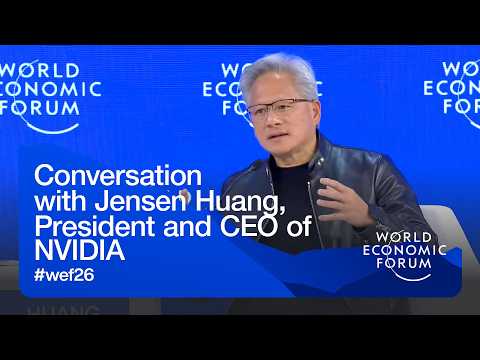
The section on the PC contains the sharpest reframing in the keynote, and it comes from Jensen Huang, appearing remotely.
The personal computer, he observes, has evolved from a tool a person uses into a tool used autonomously by an AI assistant (27:29). His example is mundane and precise: text your PC while travelling, have it start the tools installed on it, make the changes you asked for, and iterate with you while you are elsewhere.
The implication for a thirty-year software platform is substantial. Windows applications were designed around a person present at the machine — visible state, confirmation dialogues, undo, the assumption that someone is watching. Software driven by an agent while nobody is at the desk inverts every one of those assumptions, and almost none of the installed base was built for it.
The strategic argument
The part of the keynote that will matter longest is not about silicon at all.
Nadella's framing is a transition from consuming frontier models to participating at the frontier (2:07:40). What an enterprise brings is its own evaluations, its own reinforcement signal, its own traces and its accumulated knowledge — scaffolding a model can improve against. Differentiation moves to what you control rather than which model you licensed.
This is a serious argument and it is also a strategic position. If differentiation lives in the model, the model vendors capture it and everyone else is a customer. If it lives in evaluations, traces and domain data, then the platform holding those assets is where the value settles — and Microsoft is proposing to be that platform.
Whether enterprises can actually produce good evaluations is the open question. The industry's experience so far is that most organisations struggle to say what good looks like in a form precise enough to optimise against, which is exactly the capability this vision requires them to develop.
The line that carries the whole thing
Buried in a conversation late in the keynote is the formulation that explains the rest: instead of humans producing outputs, machines produce them, and the entire space has to be rethought in that context (1:39:45).
Every announcement in the two hours is downstream of that sentence. Agent identity and always-on defence exist because software acting without a person present needs to be authenticated and constrained like an employee rather than trusted like a process. The CPU ratio shifts because machines generate work differently from people. Windows becomes an execution surface because the operator is no longer in the room.
The claim is not that AI helps people produce more. It is that the producer changes, and that everything built on the previous assumption needs revisiting. That is a much larger claim than a product announcement, and the honest thing about this keynote is that it says so plainly.
Related appearances by these speakers: Jensen Huang's GTC 2026 Keynote: Vera Rubin, the Groq Deal and the Inference Inflection · Huang's Five-Layer Cake: The Infrastructure Argument He Took to Davos
Key numbers
Talk chapters
Key takeaways
- 01
The stated design equation is tokens per dollar per watt, with the system framed as electrons entering one end and tokens leaving the other. 18:16
- 02
Microsoft claims 30 per cent more tokens per dollar from its own accelerator than from the leading GPU available today, validated against a frontier model. 22:49
- 03
Running agents makes the CPU matter, with the ratio to accelerators possibly approaching parity — corroborating what practitioners described independently at the same conference. 22:49
- 04
Huang reframes the personal computer as a tool used autonomously by an assistant rather than by a person present at the machine. 27:29
- 05
Nadella's strategic argument is a transition from consuming frontier models to participating at the frontier through private evaluations, reinforcement signal and traces. 2:07:40
- 06
The line underneath every announcement: instead of humans producing outputs, machines do, and everything built on the previous assumption needs revisiting. 1:39:45
Entities mentioned
Related talks

Jensen Huang used NVIDIA's 2026 GTC keynote to argue that AI has crossed an inference inflection: models that once only generated text now reason and act, and each step multiplies the compute a single task consumes. He put NVIDIA's forward demand visibility above one trillion dollars through 2027, then spent much of the keynote explaining why that is a factory-economics claim rather than a chip claim — a gigawatt of AI factory costs roughly forty billion dollars before any compute is installed, so throughput per watt is what determines revenue. The technical centrepiece was the Vera Rubin platform; the strategic surprise was NVIDIA absorbing the Groq team to cover the low-latency decode that NVLink alone cannot reach. He closed on two extensions of the agentic thesis: OpenClaw as an emerging operating system for agents, hardened for enterprises as NemoClaw, and physical AI, where four new robotaxi partners add roughly eighteen million vehicles a year.
Huang brings a diagram to Davos: AI as a five-layer cake running energy, chips, cloud, models, applications — with economic benefit landing at the top and every layer below it a precondition. His argument for why this is a genuine platform shift rather than a product cycle is the strongest part, and it does not rest on his commercial position: software was pre-recorded and worked on structured data, whereas a machine that reasons about unstructured input and inferred intent makes previously impossible applications possible. What the framing accomplishes is worth noticing separately. By presenting the layers as a chain rather than a portfolio, it converts infrastructure spending from a bet into a prerequisite, and the question of proportion between layer-two spending and layer-five value stops being askable. Read against the GTC keynote two months later, the same business gets two framings: one a case for choosing his product, the other a case for the category existing at the scale he needs.

The rare enterprise session that describes the wiring rather than the outcome. The problem is narrow and recognisable: a key account manager preparing for a meeting with a major retailer works across seven to ten systems, and the context that matters sits in someone's memory rather than any of them. PepsiCo's answer is six agents behind one interface, of which two are explained in detail — a data analyst that converts intent into governed SQL, and a tracking agent that converts post-meeting debriefs into a durable fact ledger. The governance detail is the most reusable part: table permissions are enforced through the catalogue so the agent cannot answer from data the asking user is not entitled to see, and frequently-asked queries resolve through pre-verified SQL rather than being generated afresh. Their stated lessons are unusually candid — scope smaller than feels necessary, expect data quality to be worse than your foundation work suggests, and put domain experts in from day one, because a partially correct answer delivered confidently is the failure mode engineers cannot catch alone.

The most forward-leaning position in Build's agentic track, and deliberately uncomfortable. Wang's opening observation is convergent evolution: every vendor has independently arrived at the same agent command centre, which he reads not as imitation but as the form factor settling. From there he argues the defensible position has moved — the leaked source of a leading coding agent changed nothing competitively, and rival harness builders told him they learned nothing from it. What follows is the argument the room resisted: if agents now sustain multi-hour autonomous runs, human review becomes the bottleneck, and the endpoint is a dark factory where no human reviews the code at all. He does not present this as desirable. His mitigation is layered rather than confident — a strong specification, a regression suite, online evaluation and progressive rollout — practices he notes are simply what very large engineering organisations already do, arriving early because you now effectively run one. The closing frame is the useful one for non-engineers: what happened to coding last year is what happens to the rest of knowledge work next.

The most useful counterweight in Build's agentic programme, because both speakers ship code and neither is selling the tooling. Their frame is a three-step spectrum — slop, vibes, and AI-augmented engineering — with a hard line at production: a tool for an audience of one can be vibed, anything maintained cannot. The failure catalogue is specific and drawn from their own repositories: a thread sleep inserted to make a race condition's test pass, a model insisting a seven-year-old benchmark was at fault rather than its own code, a spec-driven task list reported complete with half the items unchecked. Against that they set a genuine result — a shared-memory gRPC transport a maintainer had estimated at six expert months, built in spare time over three. The distinction they draw is sculpting rather than prompting. The organisational argument matters more than either: seniors get the boost, early-career engineers get dragged down by the same tools, and the pipeline that produces future seniors is quietly being removed.

Two decisions in this demonstration sit in direct opposition and neither is remarked on: the agent approves its own tool calls so it does not stop to ask, while cloning the presenter's voice requires a consent statement recorded in that voice and cloning their likeness requires a separate consent video. Maximum friction to copy a person, zero friction for the agent to act. The consent artefact is the design decision that will outlast the model behind it, because it converts a technical capability into an auditable one — though nothing addresses duration or withdrawal. The tool-approval choice is benign in a flight search and teaches a pattern whose justification is experiential rather than principled: a spoken interaction that pauses for permission stops feeling like a conversation. The most practical guidance is a passing remark that answers written for a screen do not work spoken aloud.