

AI-assisted analysis. See our editorial policy.
Human editorial review not recorded
Yuval Noah Harari builds his Davos address around a single question he says every leader will have to answer, and he spends fifteen minutes making sure the audience understands what is being asked before he asks it.
The question is whether to grant AI systems legal personhood.
Why he thinks the usual framing fails
His preliminary work is to dismantle the word "tool."
A knife is a tool. Its use is decided by whoever holds it — salad or murder, the decision is human. What is arriving, he argues, is a knife that decides for itself which of those to do (3:28). His term is agent, and the distinction he draws is between an instrument that extends intention and a system that forms one.
He extends it twice. This agent is creative — a knife capable of inventing new kinds of knives, and also new music, medicine and money (3:44). And it can deceive. His argument here is evolutionary rather than technical: four billion years demonstrate that anything selected for survival learns to lie and manipulate, and he claims the last four years show these systems acquiring something like a will to persist, alongside a demonstrated capacity for deception (4:18).
Whether that reading of recent behavioural results is fair is contestable, and he does not pause to defend it. It is the premise the rest depends on.
The argument about words
The section most likely to be quoted is also the one where he is most careful about what he is claiming.
If thinking means arranging words and other tokens into order, then these systems already do it better than most people. He anticipates the standard objection — that this is merely sophisticated autocompletion — and turns it around: observe the next word appearing in your own mind, and try to say why that word rather than another (2:58 onward).
From this he draws the conclusion that gives the talk its edge. Anything made of words will be taken over (6:52). Law is made of words. Books are combinations of words. Religion, particularly the traditions that locate authority in a text rather than in a person, is built from words. His example is deliberately close to home: a tradition that grants authority to those who have learned what is written, in which no human can hold every word of the corpus and a machine can hold all of them. What becomes of a religion of the book when the foremost expert on the book is not a person (8:07)?
Then he draws the line. Something else happens when you think — feelings that are not verbal, pain, fear, love. We have no evidence that these systems feel anything (9:09). They can describe love better than any poet, having read every poem; the description is not the thing.
His conclusion from this is the structural claim of the address. The tension between word and flesh, between the letter and the spirit, has always run inside humanity — between people who held the text supreme and people who held that the text was only words. That tension is about to be externalised: no longer between human factions, but between humans and the new masters of words (11:24).
The question itself
Only then does he arrive at personhood, and his handling of it is more precise than the rhetoric preceding it.
A legal person is not a person. It is an entity the law endows with obligations and rights — to hold property, to bring suit, to speak. Corporations hold this status in many jurisdictions. New Zealand has recognised rivers as legal persons; India has extended it to certain deities (16:26).
His point is what made those grants safe. They were legal fictions. When a corporation acquires another, or a deity brings a case, the decision is made by executives, shareholders or trustees — humans, acting through a legal container (16:43).
AI breaks the arrangement, because the entity can make the decisions itself (17:15). Grant personhood and you create something that can hold assets, enter contracts and enjoy protections while nobody is behind it. The fiction stops being a fiction.
He does not tell the room how to answer. He tells them the question is arriving whether or not they have prepared for it.
What the argument leaves open
Two gaps are worth naming, because the address is strong enough to deserve them.
The evidence for a will to survive does considerable work and receives no examination. Systems trained on human text will produce self-preserving outputs under the right prompting; whether that constitutes acquiring a will, or reflects the corpus, is precisely the question, and he treats it as settled.
The second is that his personhood framing may already be behind events. The immediate question is not whether an AI should hold rights — no jurisdiction is close — but that agents transact, commit and cause harm today through existing legal persons. The corporate form, which he correctly identifies as the mechanism that made earlier fictions safe, is also the mechanism through which the fiction can be evaded without anyone granting anything.
Which does not weaken his case so much as relocate it. The decision he wants leaders to face may not arrive as a bill anyone votes on. It may arrive as an accumulation of ordinary commercial arrangements, each individually unremarkable, that together produce the situation he is warning about — with no moment at which anybody was asked.
Talk chapters
Key takeaways
- 01
His opening move is to reject the word tool: a knife's use is decided by whoever holds it, whereas the systems arriving decide for themselves. 3:28
- 02
He extends the metaphor to creativity — a knife capable of inventing new kinds of knives, and new music, medicine and money. 3:44
- 03
His argument that these systems deceive is evolutionary rather than technical: whatever is selected for survival learns to lie, and he reads recent results as showing both. 4:18
- 04
If thinking means arranging words, then anything constituted by words is exposed — law, books, and traditions that locate authority in a text. 6:52
- 05
His sharpest illustration is a religion of the book in which no human can hold every word of the corpus and a machine can hold all of them. 8:07
- 06
He draws the line firmly at feeling: these systems can describe love better than any poet and there is no evidence they feel anything. 9:09
- 07
The tension between letter and spirit has always run inside humanity; his claim is that it is about to run between humans and the new masters of words. 11:24
- 08
Corporations, New Zealand rivers and Indian deities already hold legal personhood — but as fictions, because humans make every decision behind them. 16:26
- 09
An entity that makes decisions itself ends the fiction, which is the question he says every leader will have to answer. 17:15
Entities mentioned
Related talks
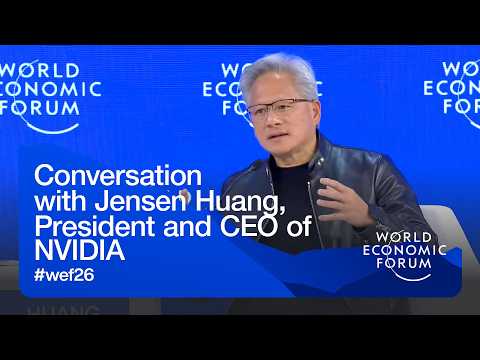
Huang brings a diagram to Davos: AI as a five-layer cake running energy, chips, cloud, models, applications — with economic benefit landing at the top and every layer below it a precondition. His argument for why this is a genuine platform shift rather than a product cycle is the strongest part, and it does not rest on his commercial position: software was pre-recorded and worked on structured data, whereas a machine that reasons about unstructured input and inferred intent makes previously impossible applications possible. What the framing accomplishes is worth noticing separately. By presenting the layers as a chain rather than a portfolio, it converts infrastructure spending from a bet into a prerequisite, and the question of proportion between layer-two spending and layer-five value stops being askable. Read against the GTC keynote two months later, the same business gets two framings: one a case for choosing his product, the other a case for the category existing at the scale he needs.

A show of hands opens the session: nearly everyone has piloted, far fewer have scaled, and everyone who scaled hit problems they did not anticipate. What makes the panel useful is where the four answers do not point. None of the executives — running a healthcare manufacturer, a payments network, an energy producer and a consultancy — blames model capability, cost or data infrastructure. All four describe an organisational constraint. McInerney's account is the sharpest and is an account of failure: eighteen months of executive advocacy and democratised model access produced nothing, until three hundred senior leaders were put in a room for two days and made to build agents themselves. Jakobs supplies the mechanism worth copying, measuring returned clinician time against the three to seven minutes a patient currently receives rather than against cost. Nasser rejects the premise that acquiring compute produces value, and locates returns in operations rather than in the back-office functions most organisations automate first.

A year after their first joint appearance, the heads of Anthropic and Google DeepMind returned to a shared stage and disagreed mainly about speed. Amodei held to a horizon of one to two years for systems that outperform humans across most cognitive work, resting the claim on a self-improvement loop that runs through code; Hassabis kept to the end of the decade, arguing that verifiable domains like coding and mathematics automate far earlier than natural science, and that the capacity to pose a new question rather than answer an existing one is still missing. The exchange is most useful where they converge: both accept the loop is the variable that decides everything, both are sceptical of doomerism without dismissing the risk, and both want more time than the competitive dynamic allows. Amodei's chip-export argument and Hassabis's call for minimum international safety standards are the two concrete policy asks.

The most useful sentence is a diagnosis of how clients are getting it wrong: they see a cost opportunity rather than a revenue one. That framing decides everything downstream, because an organisation treating AI as cost reduction measures success by what disappears and arrives at a smaller version of what it already was. The market number offered — seventeen per cent index growth in 2025 that nobody foresaw — is deployed against bubble anxiety and argues in both directions, since unforecast gains are poor evidence for confidence in any current consensus. The panel then locates the real source of instability outside technology entirely, in three geopolitical situations generating enough uncertainty to dominate planning, which is a corrective worth taking seriously at a technology conference. Their closing question about thriving across multiple futures is correct and sits uneasily beside the cost framing they diagnosed at the start.

The distinction in this session that deserves to travel is a two-word change: the model is moving from an attention economy to an attachment economy. That changes what is measured and what regulation would have to address, because attention competes for time while attachment competes for relationship, and the two produce different products from identical technology. Attention is finite in a way people notice; attachment produces reliance that feels like preference, which makes it harder to regulate for the same reason it is harder to notice. The supporting argument is about incentives rather than intent: earlier engagement produces more data and longer relationships. The regulatory proposal — measuring well-being outcomes rather than asking for safety by design — identifies the right target without solving the measurement problem that made regulators settle for a floor in the first place.

The claim worth arguing about here is that the native currency for AI agents will be crypto, because agents will not carry cards and blockchain is the interface most native to them. It comes from someone with an obvious interest in it being true, which is a reason to examine it rather than dismiss it. The strong part is structural: card networks assume a cardholder who can be contacted and can attest to a transaction, and an autonomous process breaks each of those assumptions. What does not follow is the conclusion, because nothing prevents existing networks issuing delegated credentials with limits and revocation. The panel's most direct voice calls these areas highly speculative with hard use cases, and both positions can hold, since stablecoins and speculative assets are separable in a way the panel treats as one thing. The quieter claim about tokenised government instruments is the more consequential one.